
BY Sophia Sturgeon
Each year, Harvard University’s Center for Education Policy Research and Stanford University’s Educational Opportunity Project work together to release the Education Recovery Scorecard: an annual report on district-level student growth in math and reading. In February of 2025, Idaho was ranked 38th nationally in reading between 2019 and 2024. The release went on to state that over 60% of students in Idaho are a grade level, or levels, behind in reading. It is safe to say that students are not where they need to be in terms of literacy.
Idaho’s ranking is a cause for concern, but it is not the only state suffering from literacy issues—low literacy is a nationwide epidemic. According to the National Literacy Institute, 21% of adults in the U.S were reported to be illiterate in 2024, and 54% of adults have literacy below a sixth-grade level, with 20% below a fifth-grade level. While statistics show that this low level of literacy is a direct result of inequalities in the education system, high poverty rates, and the high volume of non-native English speakers in the U.S, there is one seemingly obvious aspect that often gets overlooked: Learning to read is hard—especially when it comes to the English language.
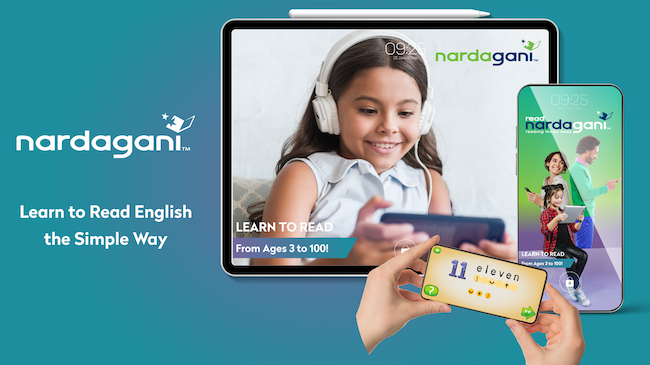
English spelling and grammar have so many rules, with just as many exceptions, which can be incredibly confusing and difficult to remember for young readers and non-native speakers. Luckily, strides are being made to help improve the confusion that often accompanies learning to read in English. One of these strides is coming from our very own Wood River Valley, with a program called Read Nardagani.
Narda Pitkethly, a longtime Sun Valley local, was inspired to create Nardagani after watching her own daughter struggle with learning to read. At her TEDx Sun Valley talk back in 2017, Narda explained that her daughter was categorized as a “challenged reader” in the first grade. “At that time, I didn’t know about challenged readers. I thought, ‘Everyone can read,’ right?”
Pitkethly traveled to Japan in her 20s to teach English and needed to learn Japanese first. She was instructed to learn how to read the language first, through a system called Hiragana; she found the system to be so easy that she learned how to read Japanese in a week. This system uses 46 “bubbly”-shaped characters, each representing a vowel or consonant-vowel combination. With Hiragana, Narda didn’t know the meaning behind the characters in a week, but she was able to correctly sound out and pronounce Japanese words.
Ten years later, when her daughter was struggling with learning to read, Narda knew she needed to take matters into her own hands. Alongside a reading specialist, Pitkethly analyzed the English alphabet and wrote down all the different sounds we use in English. Her biggest finding? Of our 26 letters, 14 of them make multiple sounds depending on the word they are in. The letter ‘O’ makes five different sounds alone! This is another aspect that makes learning English so difficult. After her alphabetical analysis, Narda, inspired by the knowledge she acquired in Japan decided to put it to good use.
Much like the Japanese Hiragana system, Pitkethly’s program, Nardagani, uses 12 easy-to-remember symbols that help readers connect letters to their proper sounds. Nardagani provides challenged readers, of all ages and backgrounds, with the tools to decode words and read them quickly and with more confidence. While this program may have started in our little Valley, pilot versions have since been tested in schools, detention centers, and international settings, and have shown participants improving reading skills of two grade levels in as little as two months! Nardagani works; that much is clear.
Nardagani was published on Kickstarter, a global funding platform for creative projects, which funds projects if they reach their funding goal by a certain deadline. The support for this program has been abundant; it has surpassed its funding goals in less than a week. According to Nardagani’s recent press release, “Funds raised beyond the initial goal will expand outreach and access, allowing more families and educators to benefit from the program.” The program’s Kickstarter will be live until March 5, 2026, which means there is still time to support the campaign; follow the QR code below to do so. If you have any questions or simply want to reach out to Narda directly, you can email her at narda@nardagani.com.
 If you know someone who you think would benefit from this reading program, make sure to check out the website www.nardagani.com, or download the Read Nardagani app, which provides you with free access to early reading levels, or you can continue learning with a full subscription for $9.99 a month.