

BY ISAIAH FRIZZELL
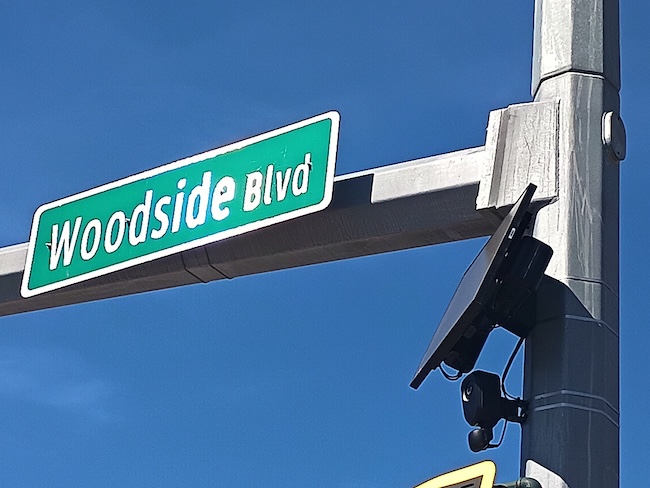
If you’ve driven all the way down Woodside Boulevard in Hailey recently and noticed a black, rounded camera near a black pole topped with a black solar panel at the light near Highway 75, you were likely photographed by a Flock camera or, rather, your license plate was.
The cameras belong to a Georgia-based company called Flock Safety, which has become one of the fastest-spreading public safety tools in America. As of 2025, Flock Safety operates in more than 5,000 communities across 49 states, and scans more than 20 billion license plates every month. Small towns have increasingly become their most enthusiastic customers.
Flock cameras are a type of automated license plate reader (ALPR). They’re mounted at places like the key entry and exit points on highways, main roads, intersections, and school zones, where each camera snaps a photo of the rear of every passing vehicle and then runs the plate against a database of stolen cars, AMBER Alerts, and, in general, vehicles of interest to law enforcement. When there’s a match, nearby police receive an alert in real time. Using AI and machine learning, trained on human data choices, the whole process takes only seconds.
At the core of what Flock does is what’s called a “Vehicle Fingerprint.” This is the make, model, color, and body type of the car, allowing investigators to search for a vehicle even when plates aren’t visible. Flock cameras aren’t recording faces and do not issue automatic tickets like traffic light cameras. They’re strictly for investigative use, not traffic enforcement.
For communities like the Wood River Valley, it’s a fairly streamlined way for a small department to handle large volume and deal with the type of growth we’re seeing here. If a home is burglarized in a neighborhood on the outskirts or a car is stolen from a trailhead parking area, investigators generally have very little to work with beyond, at best, random descriptions from potential bystanders.
With a Flock camera snapping pics of every passing car, the chances of a more precise match increase.
In larger cities, ALPR data was used in more than 40 percent of homicide investigations in 2025. Smaller towns have documented results for auto theft recovery. In Bellevue, the city council voted unanimously for two Flock cameras to be put at the north and south ends of Main Street for two years at $13,000 with the Blaine County Sheriff’s Office contributing $1,000 to help with costs. Blaine County Sheriff Morgan Ballis confirmed his office installed ALPRs at the intersection of U.S. Highways 20 and 26 in Carey, and at the intersection of Highway 20 and Highway 75 south of Bellevue.
Flock cameras are generally leased through a subscription model, usually around $2,500 to $3,000 per camera per year. The fee covers the hardware, installation, cellular service, software updates, and maintenance. The size of the city, as well as demographic and geographic factors, can determine the number of cameras. The cost, if creatively considered, can often be offset with state or federal grants.
Data is reportedly stored for 30 days by default and is to be deleted automatically unless tied to an active investigation.
Flock cameras are not without controversy. There are legitimate questions about surveillance and data use, as well as civil liberties questions that deserve public debate before a community adopts the technology. Policies governing who accesses the data, under what circumstances, and with what oversight can vary by jurisdiction. Without a doubt, the cameras are coming to smaller and smaller communities. Understanding what they are and what they aren’t is the starting point for a healthy conversation.
The Bellevue Marshal’s Office has more information at transparency.flocksafety.com/bellevue-id-pd-
A map showing Flock cameras in nearly any city in the U.S. can be found at deflock.org/map.