

BY HARRY WEEKES
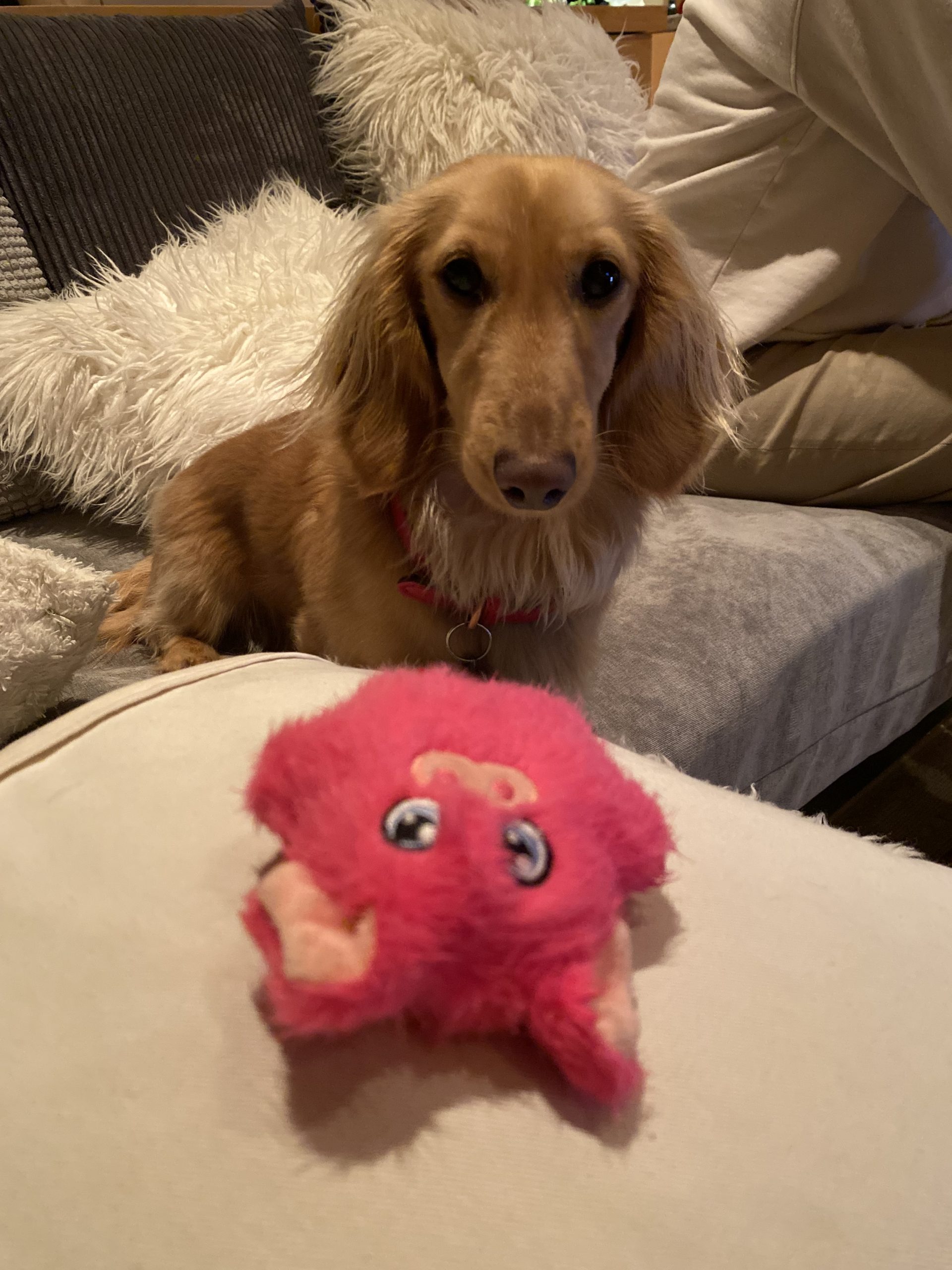
My daughter Georgia and her fiancé, Connor, visited at the end of March. They brought Honey, Whiskey’s sister, which invariably ramps up the dachshund energy and overall shenanigan quotient in the house.
It also provided another lesson in my study of dachshund language.
Olive, perhaps due to age or temperament or some combination of both, has a relatively limited vocabulary. When she barks “someone’s at the door,” it is the same phrase for the UPS driver, my in-laws coming over, or when she sees the car parked in the driveway, again. And again. Aaaaaand again. Her low whine from in front of the heater, or at the foot of the bed, or from the backseat of the car, simply means “pat me.” Her one other distinct vocalization communicates only one thing, “Deer!”
Whiskey, on the other hand, talks more. He is especially chatty when Honey is around. And it’s in his talking to Honey, and Connor, and Georgia, that I realize I know more of his language than I thought.
In the midst of a conversation with Connor, Whiskey started a low and focused groan.
Somewhere near Connor’s feet, Honey shuffled around, obscured from where I could see her. Hilary asked Whiskey, “What’s up, Mr.?”
I responded, “Is Honey chewing a little shark stuffed animal?”
Yep.
Whiskey’s “That’s Sharky” differs from “Here’s Pink Pig,” his pig chew toy that he lays at my side when he wants me to throw him. Each of these is distinct from when he offers “Lamby Lambkins,” a now well-chewed and barely recognizable sheep.
Of course, he’s also got a “Deer!” bark and several slightly different ones for visitors to the door and one he uses when he goes into the garage and barks into the emptiness. Then, there’s his singleton bark, the one he directs into the hills that echoes back to him and to which he responds, happily barking at himself, with his head cocked, no doubt thinking, “That guy sounds really, really familiar.”
Watching Whiskey react to Honey, and Connor, and Georgia, made me realize something else, at least in his physical mannerisms—he definitely recognizes people. This is no startling revelation. Dogs know people and react differently to them.
Whiskey greets Georgia and Connor with the delight of pleasant memories, and an enormous amount of wiggling.
When I get home, Olive greets me with a running version of her whine and makes the patting easier by nuzzling my feet.
Whiskey’s bark turns, even as he rounds the corner, from a generalist series of short, higher-pitched yips that communicate, “We’ve got people!” to a heavier, slower, more resonate bark.
I say my hellos in our normal greeting, calling them by name and scratching the ruffs of their necks. This is when the quality and characteristics of Whiskey’s bark elicited a simple question, “Is that what you call me?”
This evolved to wondering, “What is my dogs’ name for me?”
When I ask people if they think my dogs have a name for me (or their pets have a name for them), most people respond, “Of course they recognize you.”
I get that, but what about a name? Does Whiskey actually call me something? If there is some descriptor the dogs use, I have not yet recognized the same bark from Whiskey and Olive, so maybe her name for me is different. And maybe the name isn’t some abstraction, like “Harry,” but something more like “Is that guy who periodically gives us jerky coming home soon?”
As I know I am unlikely to answer any of these questions, even with considerable study, I am more than content knowing that, for now, I am simply a man called “Woof.”
Harry Weekes is the founder and head of school at The Sage School in Hailey. This is his 54th year in the Wood River Valley, where he lives with Hilary and their two mini-Dachshunds. The baby members of their flock have now become adults; Georgia and Simon are fledging in North Carolina, and Penelope has recently changed roosting sites to Connecticut.