

By Fran Jewell
It’s not what you think! I need to preface this with the fact (yes, it’s science) that dogs are still 99% genetically the same as wolves. That is pretty concerning to many people because that will signify to them that dogs are inherently aggressive. What is absolutely true is that dogs have inherited drives from wolves. As an example, some dogs have more “hunt” drive than others, meaning one dog may want to find ground squirrels with their nose while another wants to chase balls or have “play drive.” These drives are what are inherited from wolves.
A crucial drive from wolves is “pack drive.” What is pack drive? It is an instinctual, insatiable behavior inherited from wolves for survival. However, some individual dogs inherit more of this drive than others. Pack drive can consist of the dog’s need to be with and interact with just people, just dogs, or both.
Genetic wolf behavior is not necessarily aggression. However, that is another story. Genetic pack behavior will help us understand our dogs much better and give them a more comfortable and anxiety-free life. I don’t know about you, but that certainly is one of my goals living with dogs.
Many people will describe their dog as an alpha because he has to win all the time and will scrap with other dogs to prove his rank. Some are unstoppable and it can turn quickly into constant aggression with other dogs and even sometimes people.
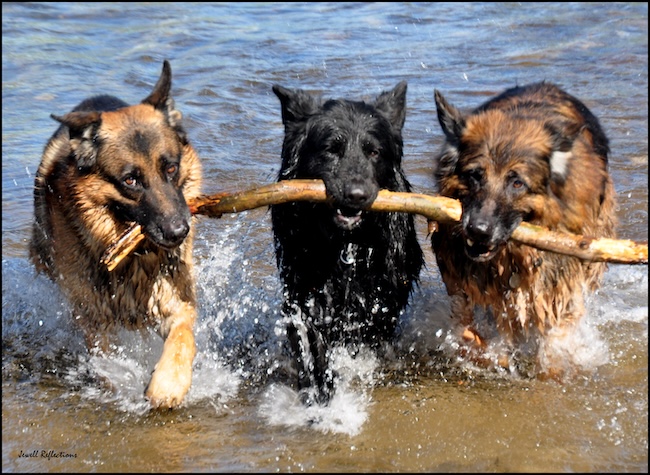
I describe dogs at home that live in a pack that have benevolent control as “high-ranking” dogs. A high-ranking dog is not a fighter, but can look at another pack member with their head a little higher, their chest just slightly more pronounced, and a tail slightly higher with a soft tip (long-tailed dogs). The other dogs immediately recognize this slight gesture and will behave. HOWEVER, if that high-ranking dog is in another pack situation, he may concede to an even higher-ranking dog. Every time new dogs get together, it is another pack. The same pack rankings may not exist as you saw at home. However, a true alpha dog will maintain that dominion over any other dog without a scrap.
This is where we as humans have some disability to be able to see the new ranking every time new dogs get together and establish another pack. It can happen in moments or in several days. As an example, I lost my high-ranking dog, Kalidor, last year to cancer. Two of the remaining boys have had a hard time with that adjustment. Steel is 3 and Crowe is 8. What has been interesting is that they still have not decided who is going to be the high-ranking dog here at my home. They don’t fight, but you can see that neither one of them thinks of themselves as higher than the other. In some moments Steel is higher ranking and does the higher ranking activities, then it can switch. Neither one of them would ever become an “alpha” in every new situation.
A true alpha never fights. They don’t have to. The other dogs recognize who they are instantly. It’s almost like they wear a general’s uniform. A true alpha may even give a toy to a lower-ranking dog. This is why it is so complex for us humans to try to understand.
In general, the rule is that true alpha dogs NEVER have to fight. They may roll another insubordinate dog from time to time, but it very rarely turns into an all-out fight. Dogs that fight “generally” fight from fear, not domination. There are always exceptions to every rule.
Cohesive members of the pack will change rolls often, depending on the situation. This, as I see it, is remarkable. It’s as if they know each other’s strengths and weaknesses and will help each other as the situation calls for it.
For us to maintain our relationships with dogs, we try very hard to put labels on behavior, whether it is situational or instinctual. Many of us are even oblivious to dog behavior to have a solid understanding about what is going on. The incredibly hard part of it for humans is to be as flexible as our dogs are and yet still have an understanding about what is happening. Mostly, I find in my 40 years of dog training and dog behavior consultation that even I can still miss something, or mistakenly identify a behavior. Still, we must ALL be open to learning and being as flexible as our dogs are. Every dog will teach us something new if we look for it and accept it.
Fran Jewell is a dog behavior consultant, NADOI-certified instructor and vice president. She owns Positive Puppy Dog Training LLC and can be reached at (208) 721-7221.