

BY HARRY WEEKES
I hear voices in the spring. These are mostly birds and their various chirps, quacks, clucks, and trills. We are not there yet, though, even in the brown winter we have had. Certainly, the advance guard arrives—a pair of Canada geese and their nostalgic honking, the rattling call of the red-winged blackbird just returned to the pond, and one or two more chickadees whistling in the willows. The full choir will arrive shortly even as these early birds practice for the coming chorus.
As we await full spring, there are other creatures afoot, literally, and they, too, are talking.
My morning walk loops through Indian Creek, a series of stacked trails that can be extended and shortened depending on circumstance, timing, and mood. The intersections equal decision points—Do I have enough time to go longer? Do I want to go clockwise or counterclockwise? What is my general mood?
I like to pretend the above moments amount to some kind of logical calculation. If I am honest, my decisions are based mostly on how afraid I feel and if I have managed to give myself enough of the willies that I alter my route.
Usually, I do this entirely mentally—I simply wade into the world of possible mishaps in my mind and before long every clump of sage, echoed footfall, or cluster of trees becomes a hiding spot or evidence of “things” out there. At these times, I work to channel the comforting words of others, most recently Cas Holman, and try to “let myself be part of the dark, part of the woods, part of the shadows, just another creature moving in the dark attuned to the movements of other creatures.”
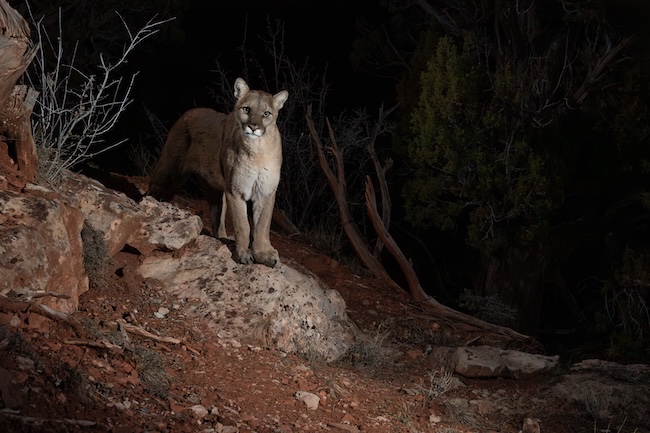
Then, there are times like the other morning when a sound comes out of the dark that stops me instantly. I still cannot fully describe what emerged from the sage shoulder out the back of the canyon, which started like a low, almost electronic rasping. It felt like a hybrid animal/digital interface that ramped up to a deep and quick clicking that stopped as quickly as it started.
I got as far as “What the…” when the same sound returned on the opposite side of the valley. The next response came—short, quick, deep. Then total quiet.
As I wondered what I heard, coyotes started their yipping conversation. The other sound was not dogs.
Timbre, pronounced tamber, describes the quality of a voice or a sound that is different from its specific physical properties, like pitch. Timbre, to me, amounts to the signature, the vocal fingerprint of a thing—why you recognize your uncle’s voice immediately or identify your dog’s bark in a sea of barking dogs.
The timbre of this crepuscular critter? Cat vibes. Big cat. Looking up mountain lions and bobcats, I got to hear chirps, whistles, purrs, screams, howls, and all sorts of “not-cat-like sounds.” I also picked up a distinct depth of sound difference between the two.
If I had to guess the sound and circumstance, I would say a mountain lion asked a simple question, “Where are you?,” while simultaneously broadcasting, “I am here.” The other cat responded, “I am over here.” Two felids looking for one another in the darkness before dawn. This is all they needed.
My crunching feet let them know which decision I made—I decided to take the short way home.
Harry Weekes is the founder and head of school at The Sage School in Hailey. This is his 54th year in the Wood River Valley, where he lives with Hilary and their two mini-Dachshunds. The baby members of their flock have now become adults; Georgia and Simon are fledging in North Carolina, and Penelope has recently changed roosting sites to Connecticut.