

BY HARRY WEEKES
There is a tendency to come to this part of Idaho and describe the hills simply as “sage,” and an inclination to leave the description there, as though the area is one monotonous carpet of shrub.
While this description is always an overstatement, there is no time this is more obvious than late April and May, when the snow clears, the rains come, and the ground erupts in wildflowers. This is when the natural world becomes magnetic. As in, “Have you seen the lupine out Rotarun?” “What about the flowers in Greenhorn?” And you know what, people go. On foot, by bike, in their cars. They are not disappointed.
Walking out into the sage in the spring, you realize just how much “not sage” there is. Everywhere. There are sprigs and sprays, tufts and tussocks, clusters and clumps. The wildflowers show up as singletons there, great groupings here, a swath across the middle of the ridge, and a smattering in the creekbed.
People who look at me sideways when I ask if they saw the harrier in the meadow now start questioning me about the distribution of arrowroot, the location of larkspur, and the color of lupine. “Why do they start out in the middle of the hills?” “They seem to be found alone, why is that?” “Why are some white and others yellow and others so purple?”
It is wonderful. To watch people respond to this seasonal flush, to make a point of getting out into the sage, to simply giggle with the delight of so much color and life. The flowers act like a moving, rhythmic timeline, with Bellevue and Hailey’s now, Ketchum’s tomorrow, and Galena’s distant future. The flower wave of life ripples up the valley and into the side canyons, splashing colors into every nook and cranny.
One of the many ways that we are spoiled here is that you never have to go far to see this. For my part, I simply drift through the immediate hills.
Hilary, Olive, Whiskey, and I are roaming for wildflowers. In the arithmetic of our “hike,” one is focused on creating a bouquet, two are focused on scent trails that will lead them repeatedly astray, and one provides an audiotrack, apparently set on “random nature.”
“This rock is literally covered in lichen—it looks like a coral head. This one is called gold cobblestone. And this one is orange rock posy. How many seeds do you think all these flowers will produce? Do you think those Douglas fir will take over this entire hillside?”
We get back to the house, mostly together. From the looks on their faces, I would say the dogs had the best time, and that period when they were “lost” was simply from a human perspective. Then, I realize Hilary’s time is just starting as she stands over a small clutch of plants, cooing in delight.
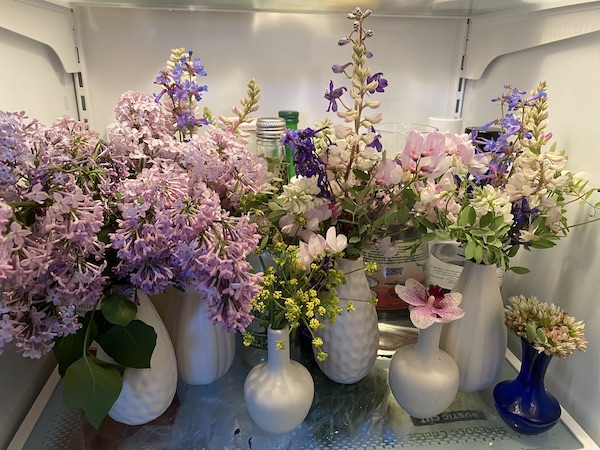
Lupine, larkspur, nodding onion, biscuitroot, wild pea, and beardtongue all receive special treatment. They are arranged together, alone, amidst lilacs, and near a household orchid that dropped a bud. They adorn the kitchen counter, the dining room table, and the table on the patio. They will spend many weeks moving about the house, attracting wasps, ants, flies, and bees to them, even forming little seed heads which we return to the sage.
Hilary keeps them vigorous by putting them in the refrigerator each night, mimicking a critical part of their daily cycle, which adds a magical element to my own.
I make lunch each morning, which requires going into the fridge. For almost all of May, my special treat is that I also get to have flowers for breakfast. All of this, in a sea of sage.
Harry Weekes is the founder and head of school at The Sage School in Hailey. This is his 53rd year in the Wood River Valley, where he lives with Hilary and two mini-Dachshunds. The baby members of their flock have now become adults—Georgia and Simon are fledging in North Carolina, and Penelope is fledging in Vermont.